Reviewed by Florent Delente, Founder, ILA Global Consulting. Last updated: October 2026.
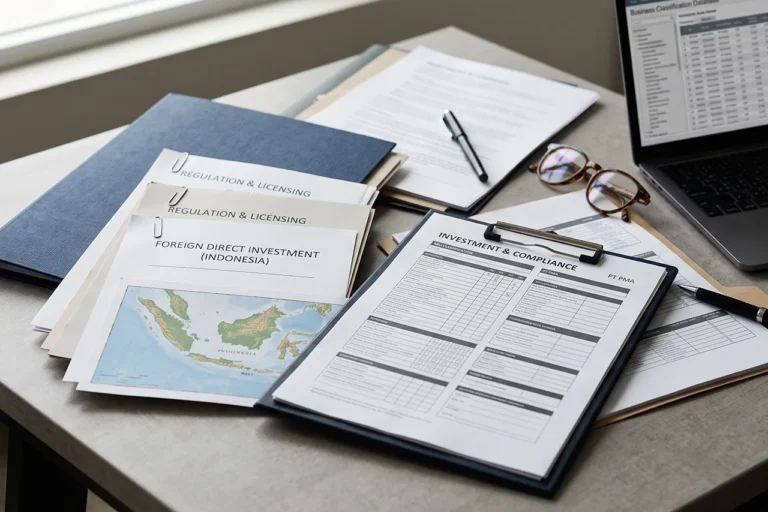
To check an Indonesian company, start with the Ministry of Law’s company register, AHU Online (ahu.go.id). A free search confirms the company exists and shows its legal status; a downloadable profile, IDR 100,000 for the latest data or IDR 500,000 for the full history since 1 August 2026, shows its capital, shareholders, directors, commissioners and deed history. Then check its business licence (NIB) and business codes in the OSS system, its beneficial owner, court records, tax status and any land it claims to hold.
This guide is for foreigners about to sign with an Indonesian company: a villa developer, a landlord, a supplier, a joint venture partner, or a company whose shares you are buying. Each check below says where to do it, what it costs and what it does and does not tell you. When the deal is large, or something does not add up, ILA’s due diligence team runs the full review and reads the documents with you. Dollar figures use IDR 17,900 per USD (Katadata, 5 October 2026) and are approximate.
Why check an Indonesian company before you sign?

Because a business card, a website and a notarised-looking PDF prove very little. In Bali, the provincial government reported that 19,262 foreign investment companies were registered between 2021 and 2025, and in 2025 to 2026 the authorities investigated 426 of them and sanctioned 423, for problems such as fictitious companies, missing building and environmental permits, activities closed to foreign investment and unmet investment thresholds (Emerhub, 18 May 2026). A company can exist on paper and still be unable to do what it is selling you.
Typical situations where a check pays for itself:
- Buying off-plan or leasing a villa from a “developer” PT: does it hold the land, the building permit and a licence for property development or sales?
- Signing a long lease with a company as landlord: is the person signing actually a director with authority?
- Paying a deposit to a supplier or contractor: is the company active, and is it already being sued or under a debt restructuring order?
- Buying shares in an existing PT or PT PMA: who really owns it, and what has been filed (or not) with the Ministry, the tax office and the investment ministry?
- Entering a joint venture: does your partner’s company match what you were told about its capital and shareholders?
Which registries can you search, and what does each check cost?
No single database answers every question. This table is the checklist we use as a starting point.
| What to check | Where | Government cost | What it tells you |
|---|---|---|---|
| Company exists, legal status, SK number | AHU Online, free search | Free | The company is registered with the Ministry of Law |
| Full company profile (history) | AHU Online, “Unduh Data Lengkap Perseroan” | IDR 500,000 (about USD 28) per document | Capital, shareholders, directors, commissioners, business purpose, every deed and approval |
| Latest company profile | AHU Online, “Unduh Data Perseroan Perubahan Terakhir” | IDR 100,000 (about USD 6) per document | The current state after the last amendment |
| Business licence and KBLI codes | OSS, NIB search | Free | Whether the NIB exists, the business codes and licence status |
| Beneficial owner | AHU Online, beneficial owner search | The natural persons who ultimately own or control the company | |
| Pending court cases | Each court’s SIPP (case tracking system) | Free | Civil suits, including bankruptcy and debt restructuring (PKPU) |
| Past judgments | Supreme Court decisions directory | Free | Published decisions involving the company or its directors |
| Tax compliance | The company shows you its SKF or KSWP status from Coretax | Free for the company | Whether it files returns and has no unpaid tax |
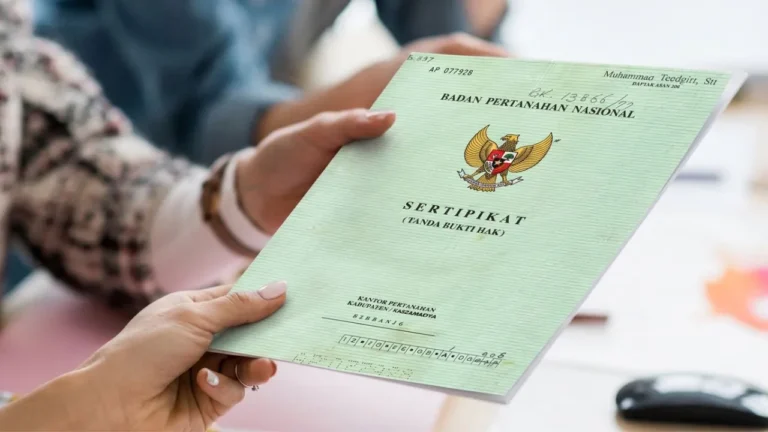
| Land title | Land office (BPN) certificate check | IDR 50,000 (about USD 3) per certificate | Owner, title type, expiry, blocks, seizures and disputes |
| Assets pledged to lenders (fiduciary) | AHU fiduciary register | IDR 50,000 per request | Whether movable assets are already pledged |
| Trademarks | PDKI, DGIP | Free | Who owns the brand you are paying for |
AHU and fiduciary fees: PP 30/2026, annex items A.8, A.9 and I.5, in force since 1 August 2026. Land check: Gebrak, 13 July 2026.
What changed in 2026: PP 30/2026 replaced PP 45/2024 as the Ministry of Law’s fee schedule. The full profile stayed at IDR 500,000, while the latest profile went from IDR 50,000 to IDR 100,000 (Legalmondo, October 2025 for the old figures; IKPI, 15 July 2026 on the new regulation).
How do you search a company on AHU Online?
AHU (Administrasi Hukum Umum) is the directorate of the Ministry of Law that keeps the register of limited liability companies under the Company Law (Law 40/2007). The site is in Indonesian only.
Free search, step by step
- Go to ahu.go.id and open the company search (“Pencarian”, then “Perseroan” or the profile search at ahu.go.id/pencarian/profil-pt).
- Type the company name without “PT” and complete the captcha. Indonesian company names often differ by one word, so search for the exact name in the contract.
- Read the result: name, registered address, the Ministry’s decree (SK) number and the company’s status (izin.co.id, 27 July 2026).
Two variations: a CV, firm or partnership is not a PT and is searched under “Badan Usaha” (non-legal entity businesses); and a sole-shareholder micro company (PT Perorangan) is searched on a separate portal, ptp.ahu.go.id.
Ordering the profile. From the result, choose the full or latest profile, pay the PNBP fee (the state’s non-tax revenue charge) through the payment code, and download the PDF. Order the full profile when you are buying shares or entering a joint venture; the latest profile is enough to check who signs today.
What does an AHU company profile show, and how do you read it?
The full profile covers the company’s life from its deed of establishment to its latest amendment (Legalmondo):
- Name, domicile and registered address
- Business purpose and activities (the KBLI codes in the articles)
- Authorised, issued and paid-up capital
- Shareholders, with the number and value of shares
- Directors and commissioners, with their terms
- Each deed: number, date, notary, and the Ministry’s approval or notification receipt
- For companies required to be audited, the filed financial statements
How to read it like a lawyer:
- Capital. For a PT PMA set up since 2 October 2025, the minimum paid-up capital is IDR 2.5 billion per business code (Withers). A foreign-owned company showing far less, or “issued” capital never paid up, is a warning sign.
- Who signs. Only a director can bind the company, within the limits of the articles. If the person signing your contract is a commissioner, a “manager” or a shareholder who is not a director, ask for a board resolution or power of attorney.
- Recent changes. A change of shareholders or directors in the last few months before a deal needs an explanation.
- Business purpose. If a company selling you a villa is registered only for consulting or trade, it cannot lawfully develop or rent property.
- Status. A company that has not filed its annual report notification can have its AHU access blocked, which stops any amendment, including a share sale. Since 1 August 2026, unblocking costs IDR 1,000,000 to IDR 2,000,000 depending on whether the company must be audited (IKPI, 15 July 2026).
How do you check the business licence (NIB) and KBLI in OSS?
The NIB (Nomor Induk Berusaha) is the business identification number issued by OSS (Online Single Submission, the national licensing system). The OSS home page has an NIB search by number or company name that does not require a login (izin.co.id).
What to look for:
- The NIB exists and matches the company name and address in the AHU profile.
- The KBLI codes match the business you are buying from. A villa rental needs an accommodation code; a developer needs a construction or real estate code; a café needs a café code.
- The risk level and licence status. Under PP 28/2025, low risk activities need only the NIB; medium-high and high risk activities need a standard certificate verified by the authority, or a full permit, before operating (PP 28/2025). An NIB alone does not prove a medium-high risk business is allowed to operate.
- Bali’s 2026 closure. Since May 2026, Bali has closed 18 codes to new foreign investment companies, including villa accommodation (55900), real estate rental (68111), small hotels, cafés and management consulting (ANTARA, 23 July 2026). A PT PMA that holds one of these codes from before May keeps it, but cannot add it now. If you are buying a PT PMA for its licences, that matters a lot. Our guide to business opportunities in Bali lists all 18.
For sector businesses, add the sector check: OJK’s list for lenders, fintech and crypto platforms; the Komdigi register of electronic system operators (pse.komdigi.go.id) for apps and platforms; BPOM for food, cosmetics and supplements (izin.co.id).
How do you find out who really owns the company?
Shareholders on the AHU profile are not always the people in control. Indonesia requires every company to identify its beneficial owner, the natural person who ultimately owns, controls or benefits from it, and to report and update that information with the Ministry of Law. Ministerial Regulation 2/2025 on the verification and supervision of beneficial owners requires an annual update and verification at every incorporation and change. Companies that fail to report face a reprimand, publication on a blacklist on the AHU website, and blocking of AHU access, which freezes any change to the articles, board or shareholders (SIP Law Firm, 26 February 2026).
AHU offers a beneficial owner search at ahu.go.id/pencarian/profil-pemilik-manfaat (Legalmondo). Use it, but do not stop there. Ask the counterparty to confirm its beneficial owner in writing in the contract, with a warranty.
The nominee question. If the profile shows Indonesian shareholders but everything you hear points to a foreigner running the show, you may be dealing with a nominee structure. Agreements under which someone holds shares on behalf of another person are void under the Investment Law (Law 25/2007, Art. 33). A contract with a company in that position is only as strong as the nominee’s goodwill.
How do you check court cases, bankruptcy and disputes?
- Pending cases. Every district court publishes its case tracking system, SIPP (Sistem Informasi Penelusuran Perkara). Search by party name in the court where the company and its directors are domiciled; in Bali that means one of the island’s district courts, Denpasar for most companies in Denpasar and Badung (Legalmondo on SIPP).
- Bankruptcy and PKPU. Bankruptcy and debt restructuring (PKPU) petitions are heard by the commercial courts. For a company in Bali, that is the Commercial Court at the Surabaya District Court, whose jurisdiction covers East Java, Bali, both Nusa Tenggara provinces and three Kalimantan provinces (Keppres 97/1999, Art. 2(3)). Check its SIPP as well as the local court’s.
- Judgments. The Supreme Court decisions directory publishes decisions from all levels. Search the company name and the directors’ names.
- Competition cases. KPPU decisions are searchable at putusan.kppu.go.id.
A search with no results is not a clean bill of health. Court systems do not always index party names consistently, and a dispute can sit in mediation or arbitration for months before it appears anywhere.
How do you check whether a company is tax compliant?
There is no public lookup of another company’s tax position. You ask the company to prove it. Two documents from Coretax, the tax office system in use since 2025, are useful:
- KSWP (Konfirmasi Status Wajib Pajak). A “valid” status confirms the taxpayer is registered and has filed its annual returns. KSWP is now handled in Coretax rather than the old DJP Online portal (DDTC News).
- SKF (Surat Keterangan Fiskal), the tax clearance letter. It is issued only if the company has filed its annual income tax returns for the last two years and its VAT returns for the last three periods, has no tax debt (or an approved instalment plan), and is not under a tax criminal investigation, under PER-8/PJ/2025 (DDTC News, 13 September 2026).
For a share purchase, ask for the SKF plus the last two years of annual returns and the quarterly LKPM investment reports filed in OSS, and make clean tax a condition of closing. A seller who cannot produce an SKF has a reason.
How do you check land and assets the company says it owns?
If the deal depends on land or a building, check the title, not the company’s description of it.
- Certificate check at the land office. The Land Office (Kantor Pertanahan, part of ATR/BPN) checks a certificate against its records for IDR 50,000 per certificate, usually in one working day when the file is complete. It confirms the title is registered, that the physical and legal data match, and whether there is any dispute, block or seizure recorded (Gebrak). The original certificate is needed, so in practice the check is done through the notary or land deed official (PPAT) handling the transaction.
- The Sentuh Tanahku app from ATR/BPN gives preliminary information on a plot, but the land office result is the reference for any transaction.
- Title type and expiry. A company holds HGB (right to build), not freehold. Check the expiry date and whether an extension has been applied for.
- Mortgages and pledges. A mortgage (Hak Tanggungan) is recorded on the land certificate. Pledges over movable assets (vehicles, equipment, inventory) sit in the AHU fiduciary register.
- Building permits. Ask for the PBG (building approval) and SLF (certificate of fitness). Our property due diligence service covers zoning and permits, and our PBG and SLF service regularises missing building approvals.
What red flags should make you stop?
From our files, these are the findings that most often change a deal:
- The signatory is not a director, or the director’s term in the AHU profile has expired.
- The KBLI does not match the business, for example a “consulting” PT PMA renting out villas, or a café code used for a restaurant.
- Capital below the legal minimum, or capital never actually paid up.
- A shareholder change shortly before your deal, especially from foreign to Indonesian names.
- Indonesian shareholders with no visible role while a foreigner negotiates everything.
- AHU access blocked for missing annual reports or beneficial owner reporting.
- No NIB, or an NIB for a medium-high risk activity with no verified standard certificate.
- No SKF, or LKPM reports missing for several quarters.
- The land is in someone else’s name, expires soon, or is in a zone that does not allow the use being sold.
- A PKPU or bankruptcy case at the commercial court.
- The brand is registered to someone else in the trademark database.
- The company asks you to pay a personal account, not a company account in its own name.
When is a company search not enough?
A search tells you what the registers say. Due diligence tells you whether the company can deliver what it promised and what liabilities come with it. You need the full review when:
- You are buying shares or a business, not just signing a supply contract.
- The amount at risk would hurt: a land lease, an off-plan villa, a joint venture contribution.
- The company is a PT PMA whose value depends on licences, especially in Bali after the 2026 closure.
- The registers and the story you were told do not match.
Worked example: buying 100% of a Bali villa company. The registers are the first day of work: full AHU profile (IDR 500,000), OSS check of the NIB and codes, beneficial owner check, SIPP and commercial court search, land office checks on each certificate (IDR 50,000 each), and the fiduciary register (IDR 50,000). Then the documents: every deed since incorporation, the licences and standard certificates, PBG and SLF for each building, two years of tax returns and an SKF, LKPM history, BPJS and employment contracts, leases, OTA listings and the hotel tax (PBJT) registration. The share transfer is then signed before a notary, reported to AHU and updated in OSS. If the company holds a villa code from before May 2026, confirm it is still active and that the share transfer will not trigger a new application, because a new one would be refused.
If you plan to rent out villas through such a company, read our guide to renting out property in Bali as a foreigner first, and for buying land or a villa directly, how to buy property in Bali.
Check before you pay
Most of the checks above take a few days and cost less than a dinner in Seminyak. Skipping them is how deposits disappear. ILA orders the registry documents, reads them in Indonesian, checks land and licences on the ground, and gives you a clear report on what the company can and cannot do. Contact our team with the company name and what you are about to sign. We also handle the contract and the notary steps once you decide to go ahead.
Want this guide offline? Get the free PDF version, or browse all 27 free ILA guides.
Frequently asked questions
How can I check if a company is registered in Indonesia?
Search its name on AHU Online (ahu.go.id). The free result shows whether it is registered with the Ministry of Law, its decree number and status. Then check its NIB on oss.go.id.
How much does an AHU company profile cost?
Since 1 August 2026, IDR 100,000 for the latest profile and IDR 500,000 for the full history, under PP 30/2026. The basic search is free.
Can I see the shareholders and directors of an Indonesian company?
Yes. The downloadable AHU profile lists shareholders with their shares, directors and commissioners, capital and the deed history.
How do I find the beneficial owner of an Indonesian company?
Use the beneficial owner search on AHU Online, then ask the company to confirm its beneficial owner in writing in your contract. Companies must report and update this information every year under Ministerial Regulation 2/2025.
How do I check if a company has court cases or is bankrupt?
Search the party name in the SIPP of the district courts where the company and its directors are based, the Supreme Court decisions directory, and, for bankruptcy and PKPU, the commercial court. For Bali, that is the Commercial Court in Surabaya.
Can I check another company’s tax status?
Not directly. Ask the company for its tax clearance letter (SKF) or KSWP status from Coretax, plus its last annual returns.
Is an NIB enough to prove a company can operate?
Only for low risk activities. Medium-high and high risk activities also need a verified standard certificate or a full permit. Check the KBLI and licence status in OSS.
Sources
- PP 30/2026 on non-tax revenue at the Ministry of Law, JDIH BPK
- IKPI: PP 30/2026 annual report and unblocking fees (15 July 2026)
- Legalmondo: How to find company information in Indonesia (updated 3 October 2025)
- izin.co.id: How to check company legality, AHU, OSS and OJK (27 July 2026)
- Law 40/2007 on Limited Liability Companies, JDIH BPK
- Law 25/2007 on Investment, JDIH BPK
- PP 28/2025 on risk-based business licensing, JDIH BPK
- Withers: Key takeaways from BKPM Regulation No. 5 of 2025
- SIP Law Firm: Strengthening beneficial owner regulation, Permenkum 2/2025 (26 February 2026)
- Keppres 97/1999 on Commercial Courts, peraturan.go.id
- Supreme Court of Indonesia: Decisions directory
- DDTC News: KSWP service moves to Coretax
- DDTC News: How to apply for an SKF in Coretax (13 September 2026)
- Gebrak: Land certificate check at BPN for IDR 50,000 (13 July 2026)
- ANTARA: Bali blocks foreign investment in 18 business categories (23 July 2026)
- Emerhub: Bali closes low and medium-low risk PMA licensing in OSS (18 May 2026)
- AHU Online, Ministry of Law
- OSS RBA
- PDKI, Directorate General of Intellectual Property
- Katadata: Rupiah at IDR 17,916 per USD (5 October 2026)